The global energy industry is undergoing a historic transformation. As the pressure to achieve sustainability, accelerate the green transition, and optimize operational costs continues to intensify, Artificial Intelligence (AI) has evolved from a promising technology into a strategic imperative.
Today, the critical question is no longer whether organizations should adopt AI, but rather how to integrate AI into their corporate strategy and the core of their operational systems to deliver measurable business value.
The Key Challenge: Embedding AI into Strategy and Core Operations
1. Overcoming the Barriers to AI Adoption in the Energy Sector
Despite its transformative potential, AI implementation in the energy industry continues to face significant challenges. Unlike many other sectors, energy companies operate highly complex, capital-intensive infrastructure where reliability, safety, and regulatory compliance are paramount.
Recent industry research indicates that more than 60% of AI initiatives in industrial and energy sectors fail to progress beyond the Proof of Concept (PoC) stage, primarily due to three critical barriers:
- Fragmented Data and Legacy Systems: Decades of operations have generated enormous volumes of data, yet these data assets remain fragmented and disconnected. Standardizing data from thousands of different Internet of Things (IoT) sensors to train AI models represents a major technical and financial challenge. .
- Cybersecurity and Data Protection: Energy infrastructure underpins national power grids and energy security, making cybersecurity a strategic priority. Industry surveys indicate that more than 73% of business leaders are concerned about the risks of data breaches and cyberattacks when connecting core Operational Technology (OT) systems with cloud platforms and AI solutions.
- Technology Capability Gap: A disconnect between AI engineers, who often lack deep domain expertise in the energy sector, and business leaders, who may not fully understand the capabilities, limitations, and risks of AI, prevents organizations from developing a coherent strategic vision for AI initiatives.
2. Addressing Operational Challenges with a Remote Monitoring and Control Center (RMCC)
To overcome these operational barriers, energy companies must focus on clearly defined AI use cases that deliver immediate and measurable business value.
One of the most transformative AI strategies is the development and enhancement of an AI-powered Remote Monitoring and Control Center (RMCC).
By integrating Machine Learning and Big Data Analytics, an AI-powered Remote Monitoring and Control Center (RMCC) transforms conventional power grids into intelligent Smart Grids. AI continuously monitors the health and performance of critical assets—including turbines, generators, and substations—to enable Predictive Maintenance, identifying potential failures before they occur. This proactive approach minimizes unplanned downtime, enhances asset reliability, and saves organizations millions of dollars in maintenance and repair costs.
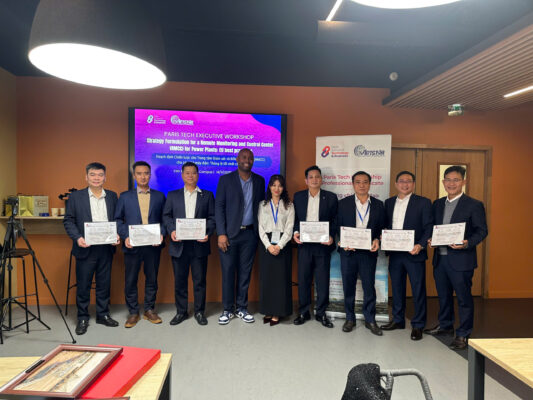
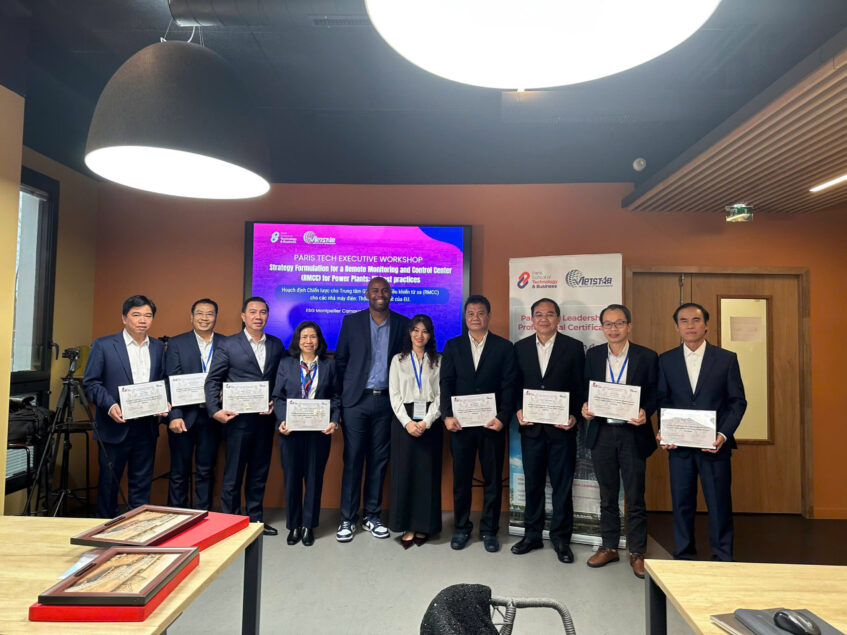
A Breakthrough in Practice: In November 2025, senior executives from Power Generation Corporation 2 (EVNGENCO2), Vietnam, had the opportunity to gain first-hand exposure to European Union (EU) best practices in Remote Monitoring and Control Center (RMCC) operations through the Innovation Strategy and Artificial Intelligence executive training program held in Montpellier, France. This experience underscores the strong commitment of Vietnamese energy enterprises to proactively embrace advanced technologies and build the capabilities required for digital transformation.
3. Developing an AI Charter: Establishing a Strong Framework for Data Security
As AI becomes deeply integrated into energy systems, automated decision-making inevitably introduces complex and unpredictable risks. The first line of defense is not technology itself, but the establishment of an AI Usage Charter—a governance framework that provides clear principles for the secure, ethical, and responsible use of AI throughout the organization.
To establish an effective AI Usage Charter, organizations must systematically refine their data security policies and develop standardized templates for assessing algorithmic risks. This process also requires the careful preparation of governance documents, implementation guidelines, and comprehensive reports on data systems, which should be consolidated into clear and well-structured internal communication materials. Such an approach ensures alignment across all levels of management and the workforce.
A well-designed AI Usage Charter establishes clear governance boundaries for AI deployment, safeguards sensitive data against unauthorized access, and promotes Explainable AI (XAI), ensuring that AI-driven decisions—particularly those affecting power grid operations—remain transparent, auditable, and accountable.
A Breakthrough in Practice: In June 2026, senior executives from Petrovietnam Drilling & Well Services Corporation (PV Drilling) participated in the AI Strategy executive training program in Paris, France, where they developed an AI Usage Charter for the oil and gas industry with a strong focus on information security and data protection. This initiative reflects the growing commitment of Vietnamese energy enterprises to establishing robust AI governance while ensuring the secure and responsible use of AI technologies.

4. France: A Launchpad for AI Excellence and the Value of the French National Professional Certification
The complexity of AI adoption and the development of an AI Usage Charter requires business leaders and executives to possess a comprehensive AI competency framework. It is no coincidence that France has emerged as one of Europe’s leading hubs—and a global center—for AI leadership education. Backed by a dynamic innovation ecosystem and strong government support, the French education system is at the forefront of integrating management excellence with advanced technology, equipping leaders with the strategic and technical capabilities needed to drive AI-powered transformation.
This is why the Paris Certificate in AI for Business—a French National Professional Certification—has become one of the most comprehensive and highly regarded programs for developing AI competencies for business leaders and executives.
Co-developed by the Paris School of Technology & Business (PST&B), Université Paris 1 Panthéon-Sorbonne, and the VIETSTAR Institute of Management & Consulting, the Paris Certificate in AI for Business equips executives with the essential competencies to lead AI-driven transformation. The program offers:
- Internationally Recognized Standard: Developed in accordance with the French AI Competency Framework, the program leads to a prestigious French National Professional Certification (RNCP), recognized for its academic excellence and industry relevance
- Designed for Busy Executives: A time-efficient three-month hybrid learning experience (50% on-site, 50% online), enabling professionals to balance executive education with their leadership responsibilities.
- No Coding Required: The curriculum focuses on AI Strategy, AI Governance, and business process automation, empowering participants to harness AI for strategic decision-making without any programming background.
- Rapid Business Impact: Designed to deliver measurable return on investment (ROI) in less than 30 days, the program equips executives with the practical capabilities to lead digital transformation and accelerate organizational performance.
In the era of data and Artificial Intelligence, competitive advantage no longer lies in merely adopting technology, but in mastering it.
Through the Paris Certificate in AI for Business—a French National Professional Certification (RNCP)—Vietnamese energy executives gain access to a world-class AI competency framework and strategic toolkit, empowering them to overcome industry challenges, lead digital transformation, and build sustainable competitive advantage in an increasingly AI-driven economy.